1. Introduction
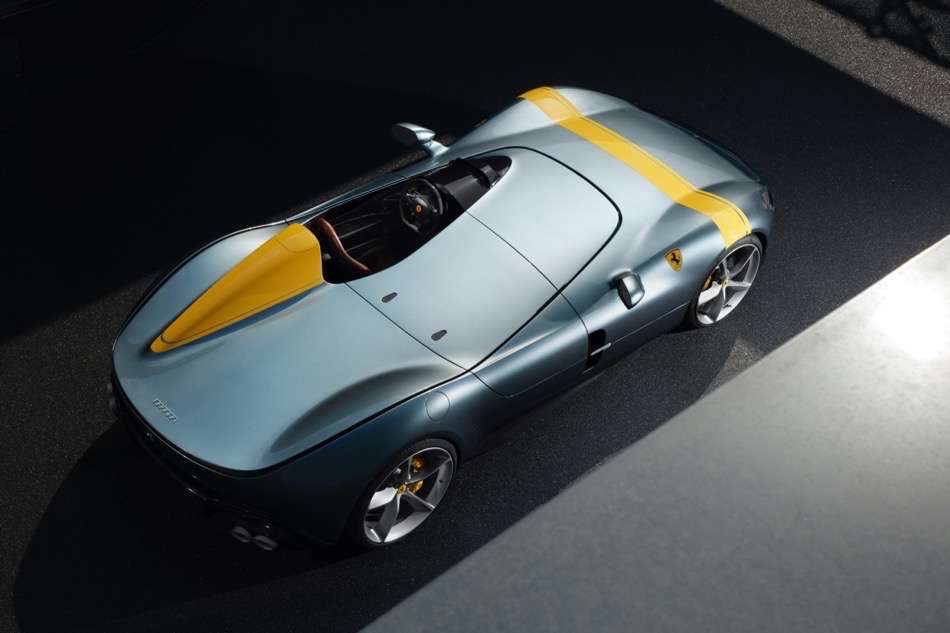
The Ferrari Monza SP1 is one of the most uncompromising modern Ferraris ever built: a single-seat, open-cockpit, V12-powered speedster created not because the market needed another supercar, but because Ferrari wanted to build a modern interpretation of its most evocative racing barchettas. It is part sculpture, part collector object, part road-legal theatre, and part mechanical tribute to the era when Ferrari sports racers were low, open, dangerous-looking machines driven by people who seemed to regard wind, rain, noise and exposure as acceptable occupational hazards.
The Monza SP1 was introduced alongside the two-seat Monza SP2 as the first model in Ferrari’s Icona series, a new limited-production family designed to reinterpret major themes from Ferrari’s past using contemporary engineering. The design draws inspiration from cars such as the 166 MM, 750 Monza and 250 Testa Rossa, but the SP1 is not a replica. It is a modern collector Ferrari built around historic emotion: no roof, no conventional windscreen, one seat, a front-mid-mounted naturally aspirated V12 and a body made almost entirely from carbon fibre. Ferrari described the Monza SP1 and SP2 as the first models in a new limited-series Icona concept, created to evoke the marque’s most iconic cars through modern technology.
Mechanically, the Monza SP1 is based on the Ferrari 812 Superfast platform, but it is far more specialised in purpose. It uses a 6.5-litre naturally aspirated V12 producing around 810 hp / 596 kW and 719 Nm / 530 lb ft of torque, paired with a 7-speed dual-clutch gearbox and rear-wheel drive. Ferrari quoted 0–100 km/h in 2.9 seconds, 0–200 km/h in 7.9 seconds, and a top speed of over 300 km/h / 186 mph.
What makes the Monza SP1 fascinating is not simply its performance. An 812 Superfast, 812 Competizione, Daytona SP3 or 12Cilindri can also deliver V12 drama. The Monza SP1’s distinction is its single-seat purity. It removes the passenger seat entirely, making the car feel closer to a personal racing machine than a conventional road car. This is a Ferrari built for one person, one driving position, one experience. It is intentionally selfish, intentionally impractical and intentionally theatrical.
Pricing and access reflect that philosophy. Total production across the Monza SP1 and SP2 was limited to 499 units, with original pricing widely reported around €1.58 million before options, or roughly £1.4 million / $1.7–$2.0 milliondepending on market and taxes. Secondary-market results have moved significantly higher, with public auction data showing Monza SP1 sales reaching several million dollars.
For SupercarTribe readers, the Ferrari Monza SP1 should be understood as a collector-grade Ferrari designed around sensation rather than practicality. It is not the easiest Ferrari to use, not the most versatile, and not the most rational investment compared with a LaFerrari or Daytona SP3. But as a statement of single-seat V12 minimalism, it is one of Ferrari’s most memorable modern creations.
2. Production & History
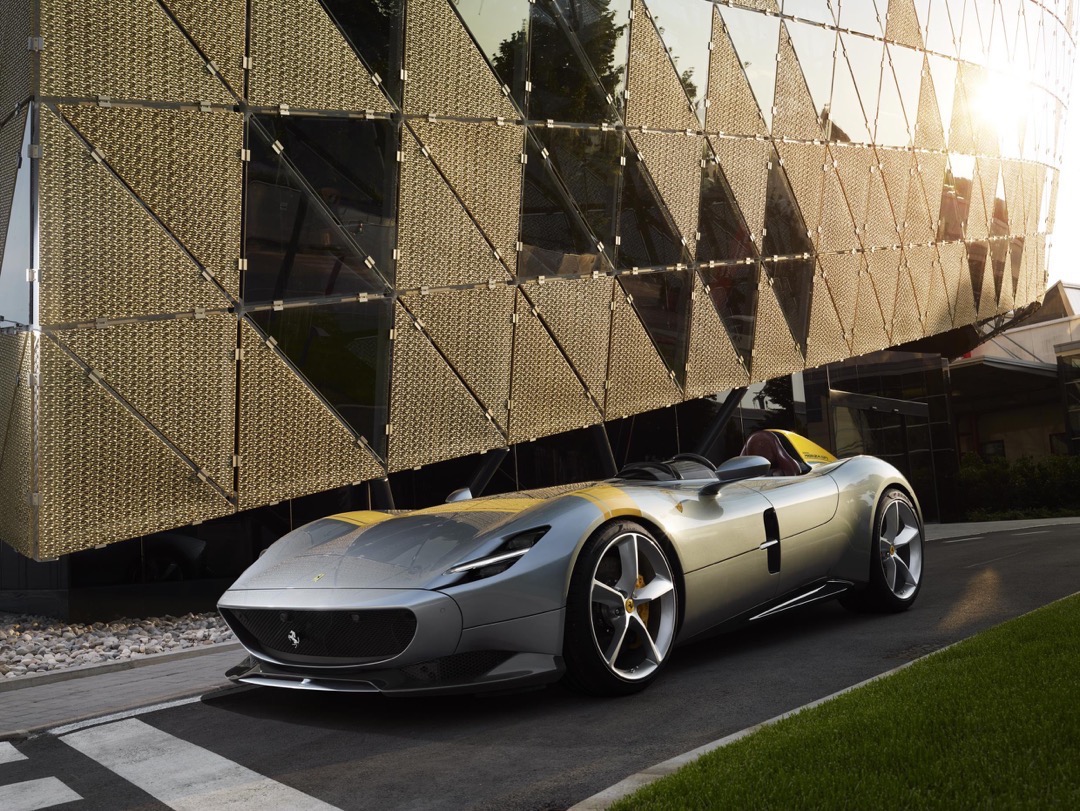
The Ferrari Monza SP1 was revealed in 2018 alongside the Monza SP2 and entered production from 2019. The two cars launched Ferrari’s Icona series, which was created to sit above normal production models and focus on historically inspired, ultra-limited collector cars. This was a deliberate move by Ferrari to monetise heritage in a more focused and exclusive way than standard special editions.
The Birth of the Icona Series
Before the Icona programme, Ferrari already had a long history of limited-production cars: the 288 GTO, F40, F50, Enzo, LaFerrari and various special-series models. However, those cars were usually tied to technological progression or motorsport-derived performance. The Icona series introduced a slightly different philosophy. Rather than simply creating the fastest Ferrari possible, Ferrari would reinterpret specific historical themes using modern platforms and materials.
The Monza SP1 and SP2 were inspired by Ferrari’s open sports racers of the 1940s and 1950s, including the 166 MM, 750 Monza and 250 Testa Rossa. These were cars from a period when Ferrari’s identity was being forged in endurance racing, road races and sports-car competition. They were light, open, purposeful machines, often with minimal bodywork and strong visual connection between driver, engine and road.
SP1 Versus SP2
The SP1 and SP2 share the same technical basis, but their identities are different. The SP1 is the single-seat version, while the SP2 has two seats. This distinction matters enormously. The SP2 is more sociable and arguably more usable, because it allows a passenger to share the experience. The SP1 is purer and rarer in feel because it removes that possibility completely.
Ferrari produced 499 units across both SP1 and SP2 variants, not 499 of each. This makes the SP1 particularly rare because most market observers believe the two-seat SP2 was the more commonly selected version. Public commentary around late-production examples has suggested that only a minority of total Monza production may be SP1s, making the single-seat car especially desirable among collectors who value rarity within rarity.
Production Period
Production ran broadly from 2019 to 2022, with model years extending into the early 2020s. The cars were assembled in Maranello and offered only to selected Ferrari clients. This was not a car one simply ordered from a showroom. Allocation was highly restricted, and many buyers were already important Ferrari collectors.
The Monza SP1 therefore occupies a very particular place in Ferrari history. It was not designed to broaden Ferrari’s customer base. It was designed to deepen the relationship between Ferrari and its most committed clients by offering something far beyond ordinary production models.
Historical Importance
The Monza SP1 is historically important for three reasons. First, it launched the Icona series, which later produced the Daytona SP3. Second, it revived the idea of a modern Ferrari barchetta in a radical, road-legal form. Third, it represents one of the purest modern expressions of Ferrari’s naturally aspirated V12 before emissions, hybridisation and electrification became even more dominant forces.
Unlike the Daytona SP3, which is a more complete mid-engined hypercar, the Monza SP1 is deliberately stripped back. It is less usable, but arguably more conceptually pure. It is Ferrari saying that some cars do not need to make practical sense to matter.
3. Design & Styling
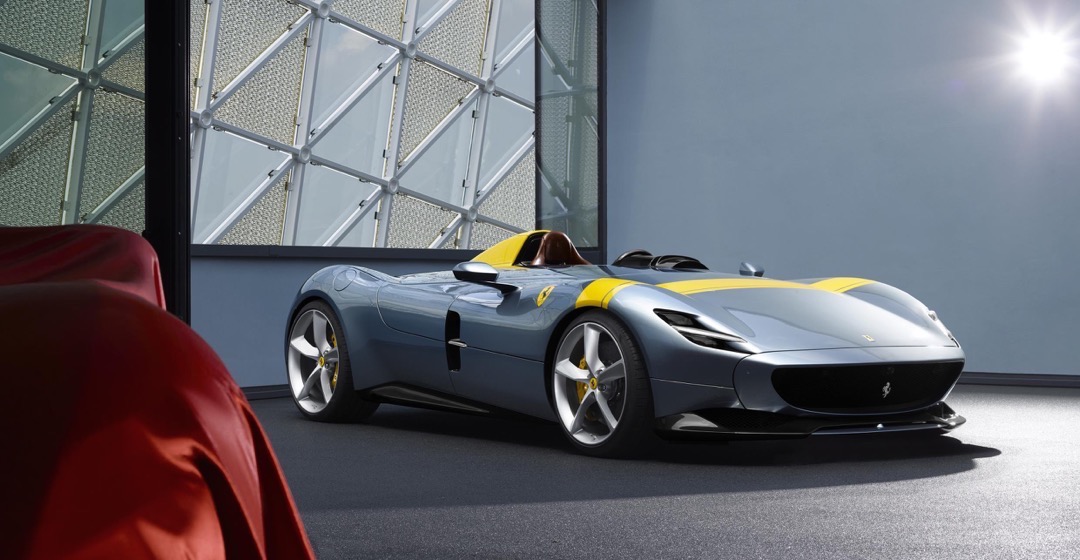
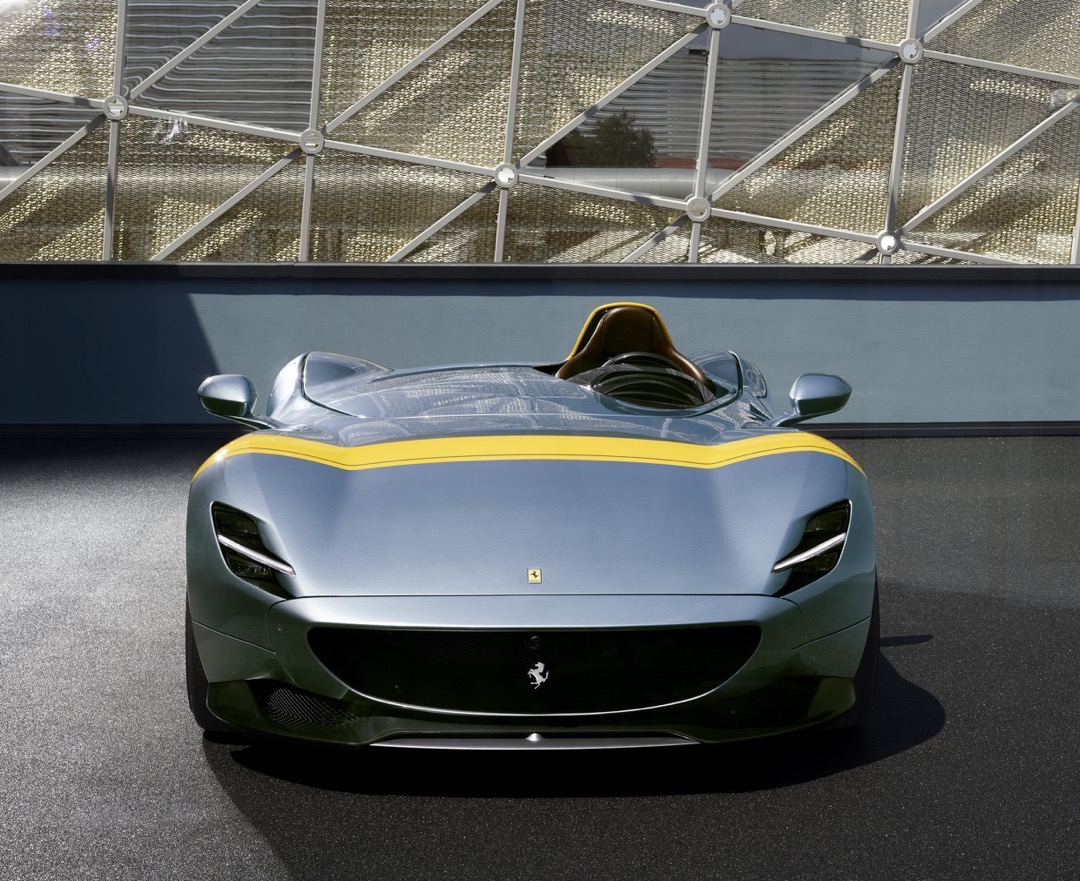
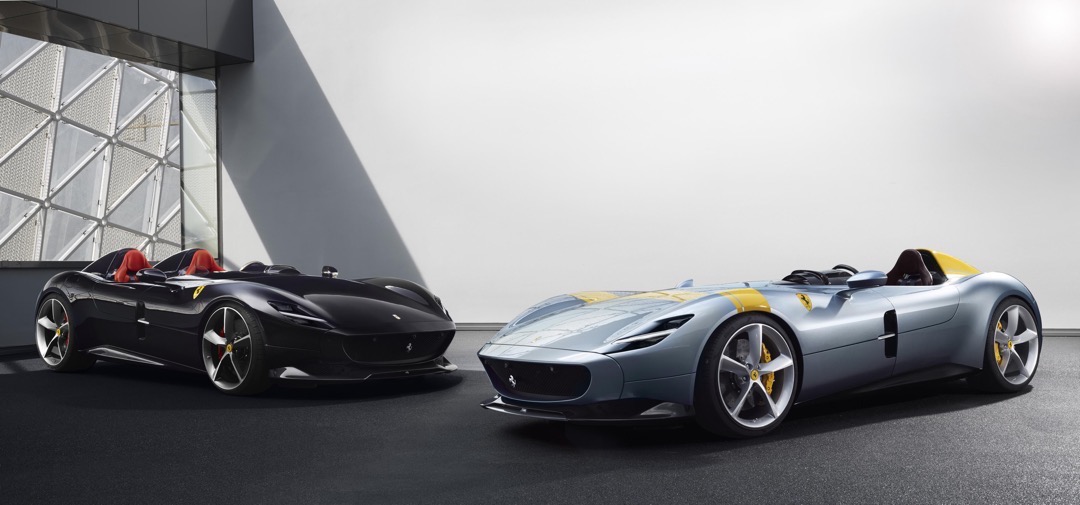
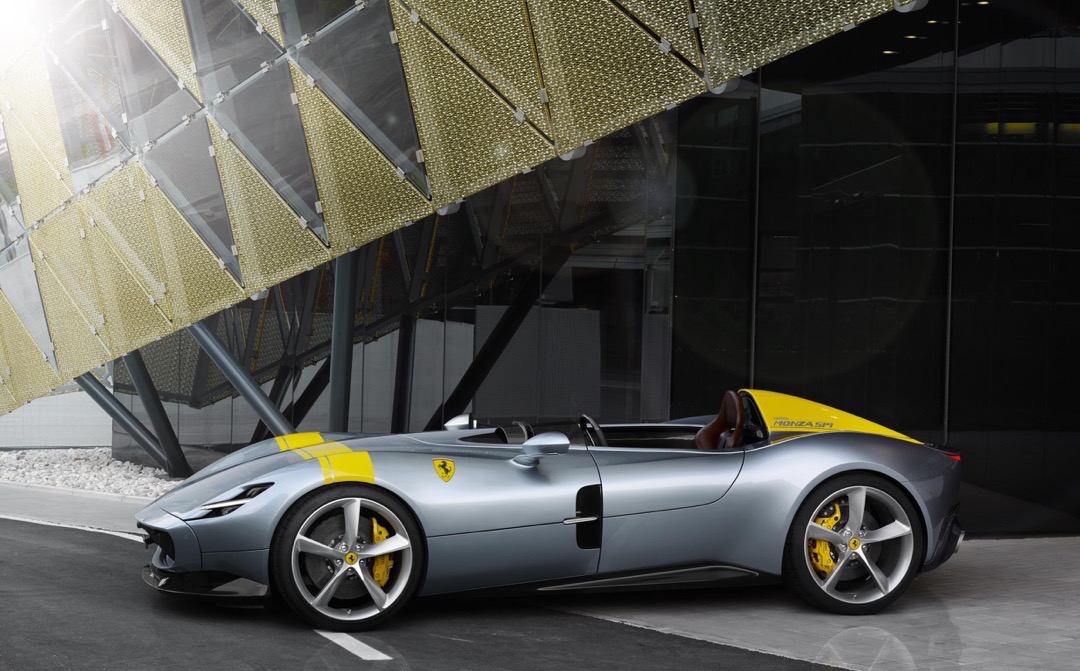
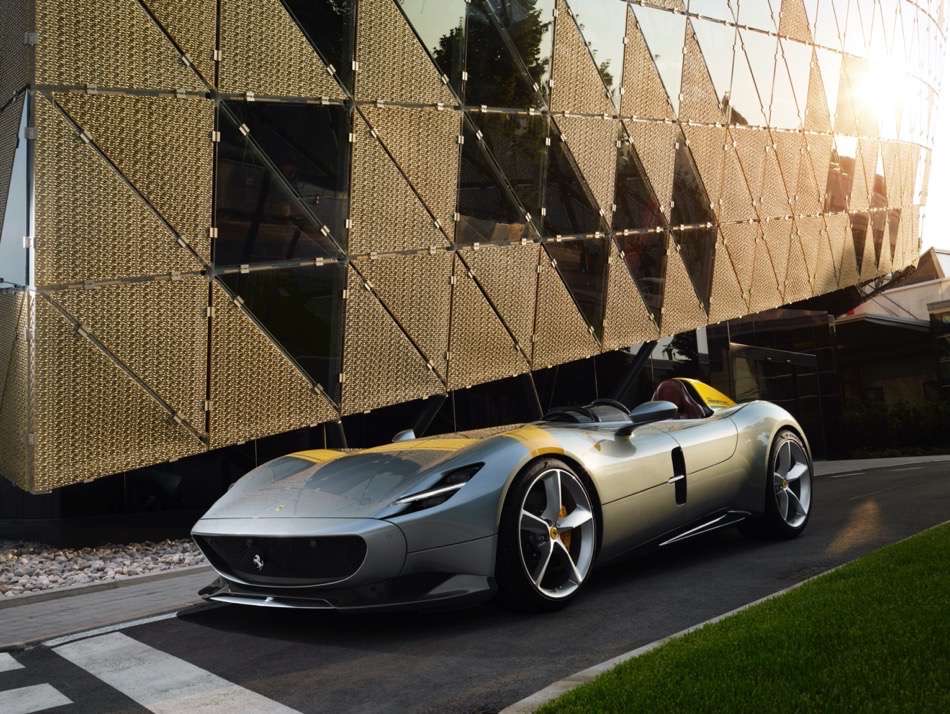
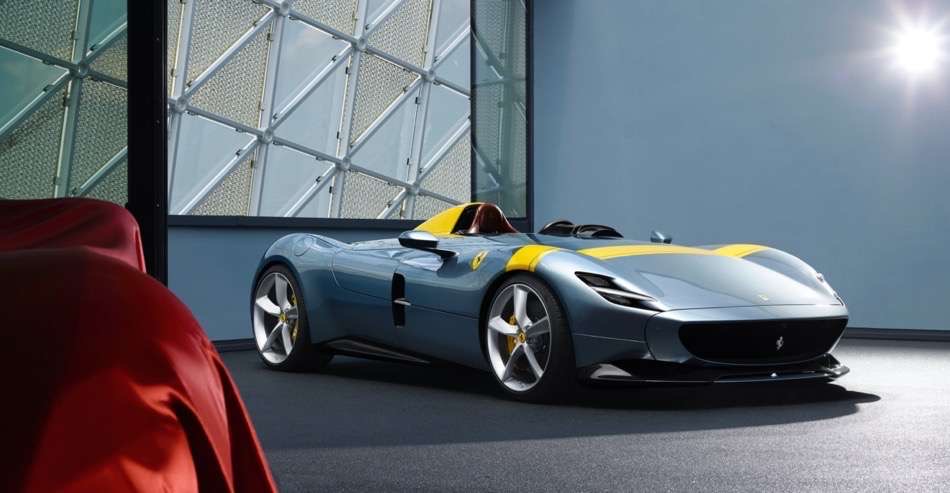
The Ferrari Monza SP1 is one of the most visually arresting modern Ferraris because it rejects many of the conventions of contemporary supercar design. There is no roof, no conventional windscreen, no passenger compartment in the normal sense, and no attempt to make the car look practical. The design is a modern barchetta: low, long, exposed and intensely sculptural.
Exterior Proportions
The SP1’s proportions are dramatic because of its front-mid-engined layout. The bonnet is long and low, the cockpit sits far back, and the rear deck is tightly shaped around the driver’s compartment. The absence of a second seat creates an asymmetrical feeling, even though the exterior remains carefully balanced. From some angles, it looks less like a car and more like a speed-form object designed around one person.
Its bodywork is made from carbon fibre composite, helping reduce weight and allowing Ferrari to create flowing surfaces that would be difficult to execute with conventional materials. The long front clamshell, smooth flanks and open cockpit directly reference Ferrari’s early sports racers, but the surfacing is unmistakably modern.
No Windscreen, No Roof
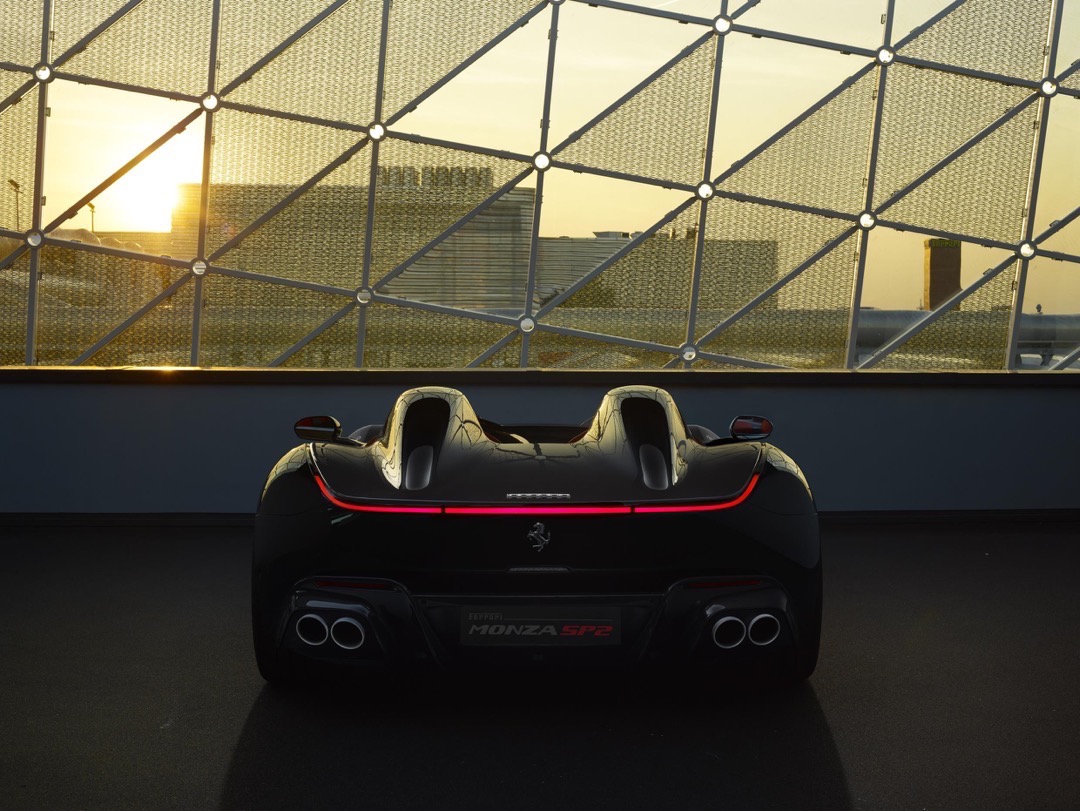
The most important design decision is the absence of a conventional windscreen. Instead, Ferrari developed what it called a Virtual Wind Shield, an aerodynamic solution designed to deflect air over the driver and improve comfort at speed. This does not make the SP1 as refined as a normal convertible. It simply makes the experience more manageable than it would be if the driver were fully exposed to direct airflow.
The lack of roof and windscreen changes the entire visual identity. Most convertibles are closed cars with the roof removed. The Monza SP1 is not that. It was designed from the beginning as an open machine. That is why it feels coherent rather than compromised.
Single-Seat Drama
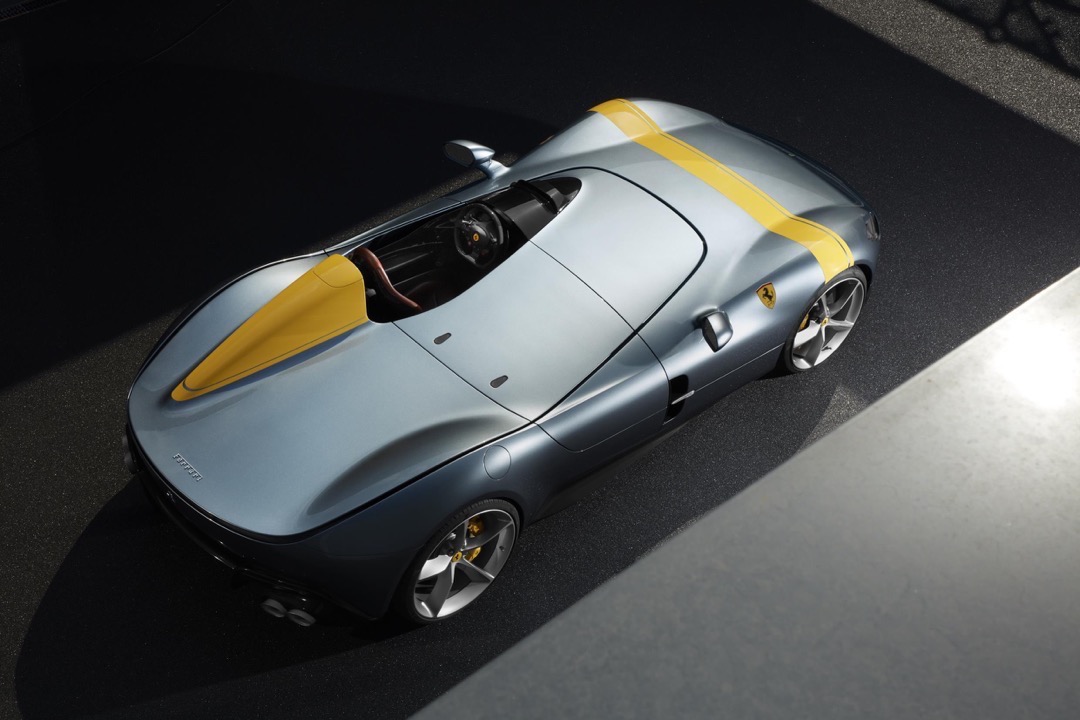
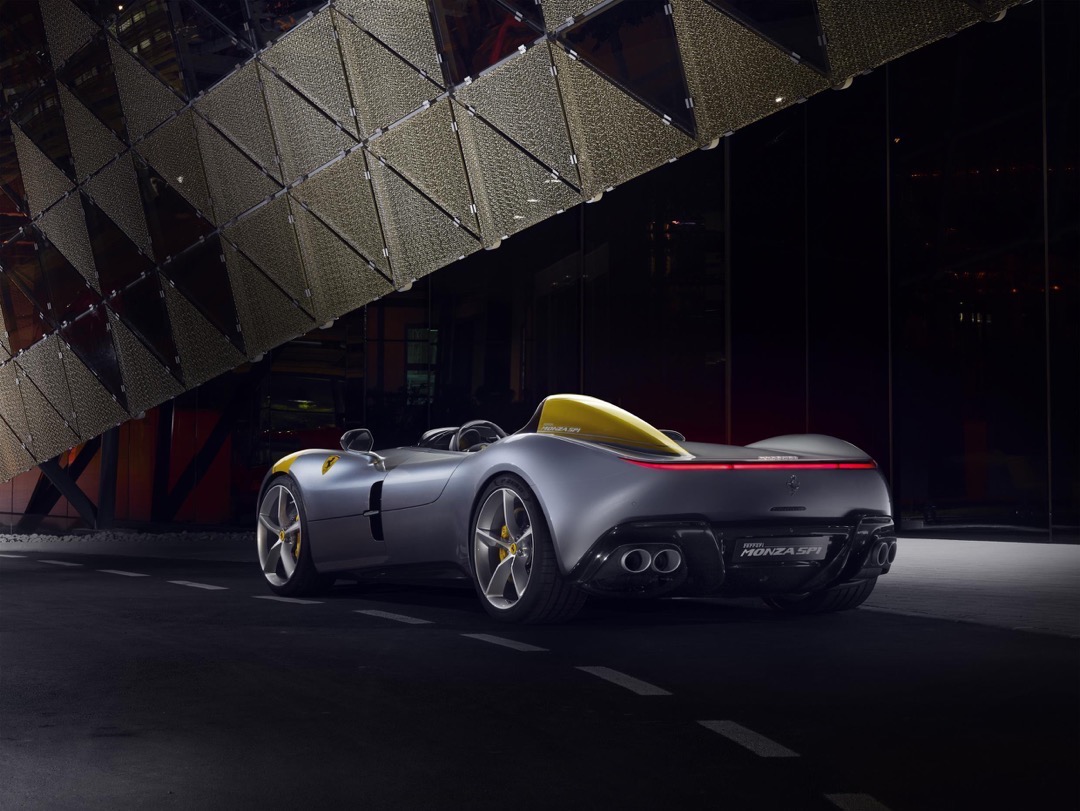
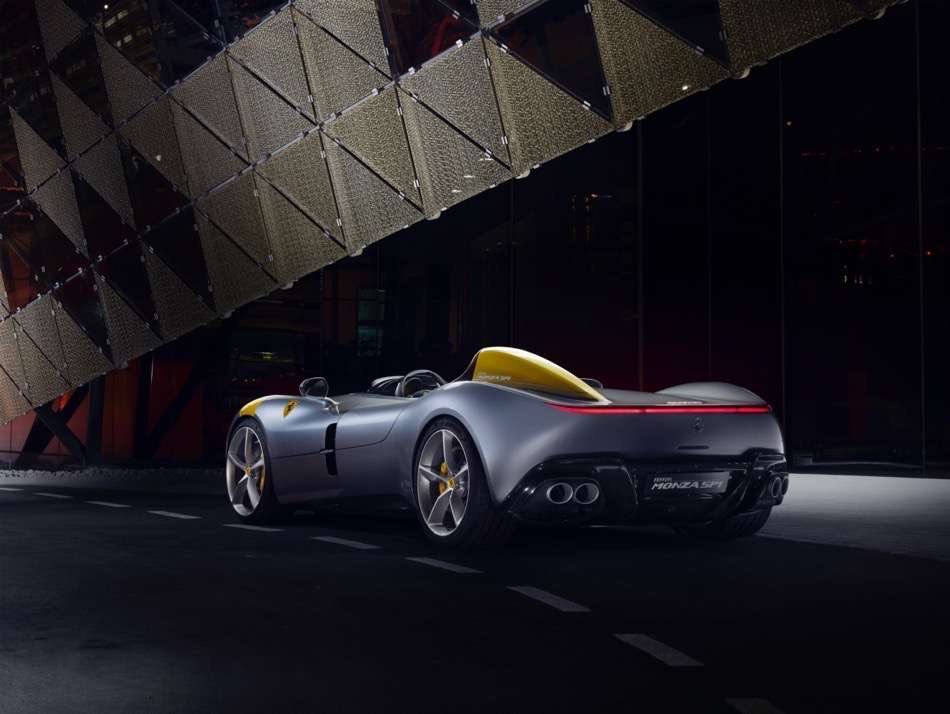
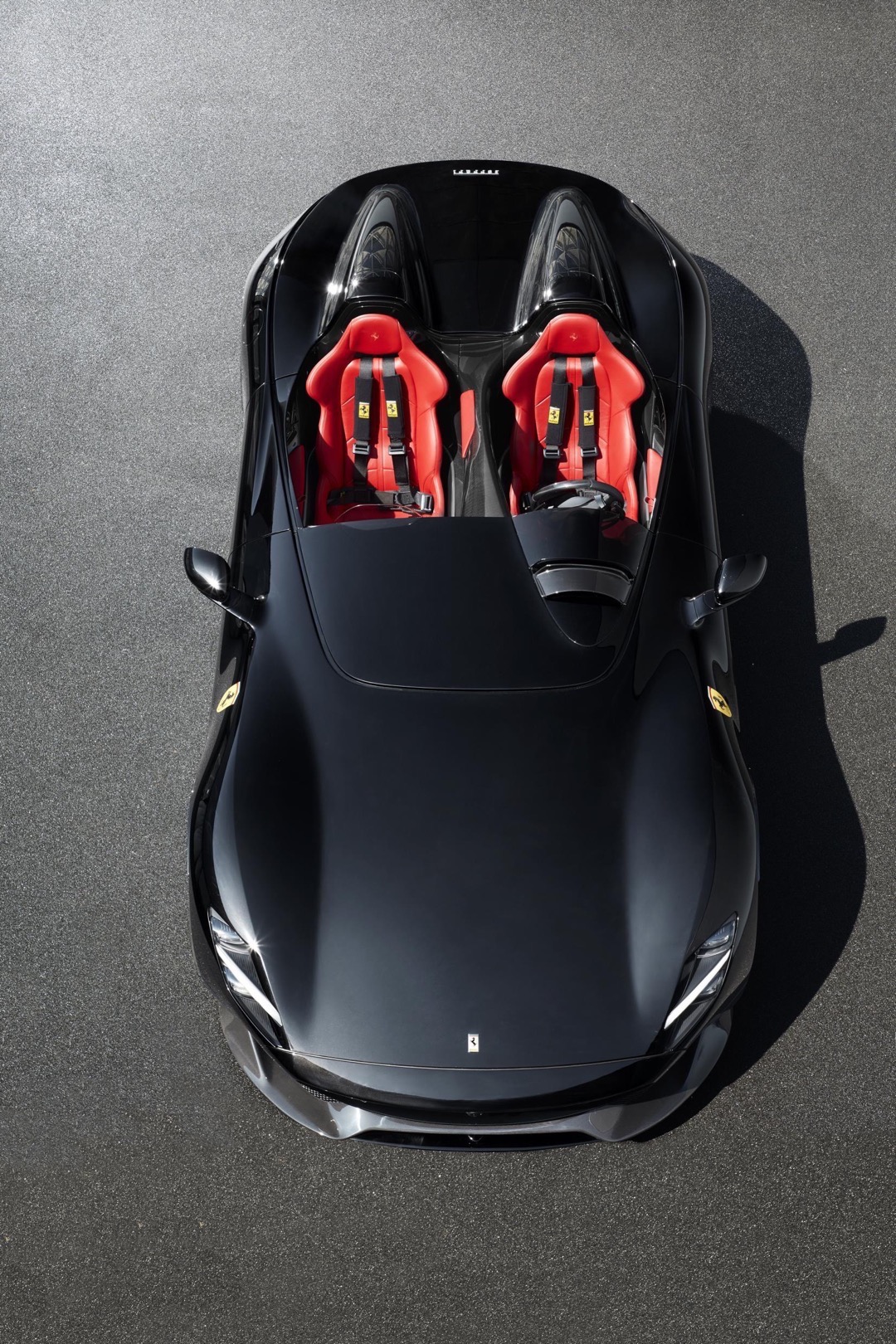
The single-seat layout is the SP1’s defining styling feature. The passenger side is covered by a sculpted tonneau-style section, turning the car into a one-person cockpit. This gives the SP1 a racing-prototype atmosphere that the SP2, despite being spectacular, cannot quite match.
It also makes the car more theatrical in ownership. Arriving alone in a single-seat Ferrari speedster is a very different statement from arriving in a conventional supercar. The SP1 is not discreet, but its drama is design-led rather than aggressive.
Interior Design
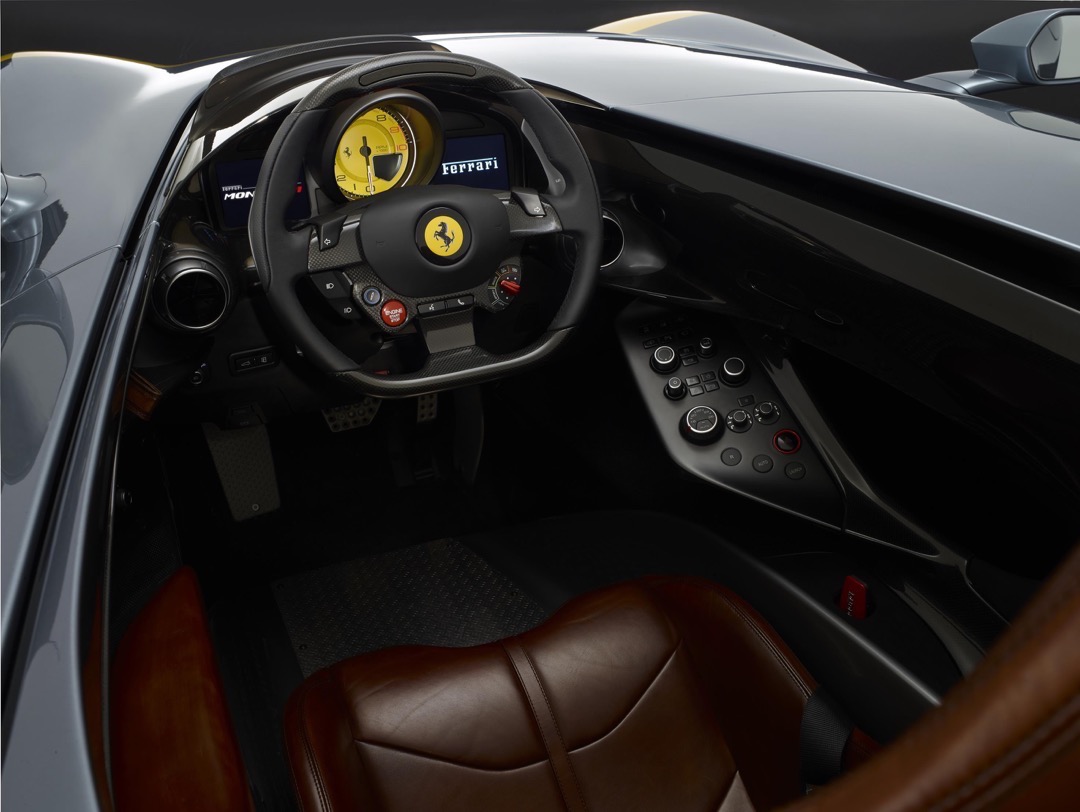
The interior is minimal but expensive. The driver sits low, surrounded by carbon fibre, leather, Alcantara and bespoke finishes. The cockpit is compact and focused, with controls familiar from contemporary Ferraris but presented in a far more elemental environment.
Unlike the Roma or Purosangue, the Monza SP1 does not aim for luxury comfort. Its interior is about the driving ritual: seat, wheel, pedals, paddles, start button, V12. Everything else is secondary.
4. Engine & Technical Specifications
The Ferrari Monza SP1 is powered by a naturally aspirated 6.5-litre V12, derived from the engine used in the Ferrari 812 Superfast. In the Monza, the engine was tuned to produce around 810 hp at 8,500 rpm and 719 Nm / 530 lb ft of torque at 7,000 rpm. At launch, it was among the most powerful non-hybrid V12 road-car engines Ferrari had produced.
Core Technical Specification
Key figures include:
- Engine: 6.5-litre naturally aspirated V12
- Displacement: 6,496 cc
- Power: approximately 810 hp / 596 kW
- Torque: 719 Nm / 530 lb ft
- Transmission: 7-speed dual-clutch automatic
- Drivetrain: rear-wheel drive
- Layout: front-mid engine
- 0–100 km/h: 2.9 seconds
- 0–200 km/h: 7.9 seconds
- Top speed: over 300 km/h / 186 mph
- Kerb weight: approximately 1,500 kg for SP1
- Production: 499 units across SP1 and SP2 combined
Relationship to the 812 Superfast
The Monza SP1 is based technically on the 812 Superfast, but it is not simply an 812 with the roof removed. Its carbon-fibre body, single-seat layout, unique cockpit treatment and aerodynamic work create a very different experience. The engine may share its roots with the 812, but the way the driver experiences it is transformed by the open cockpit.
In an 812 Superfast, the V12 is dramatic but contained within a refined GT cabin. In the Monza SP1, the V12 is more exposed, more physical and more immediate. The driver hears more, feels more and has less separation from the mechanical process.
Gearbox and Drivetrain
The 7-speed dual-clutch gearbox gives the SP1 rapid shift capability while preserving usability. A manual gearbox might have suited the historical inspiration in theory, but the performance level and Ferrari’s modern V12 calibration made the dual-clutch transmission the logical choice.
Power goes only to the rear wheels. This is important because it preserves the traditional Ferrari V12 character. There is no electric front axle, no all-wheel-drive traction system and no hybrid torque fill. The driver experiences the engine through the rear tyres.
Chassis and Materials
The SP1 uses carbon-fibre composite bodywork and a structure derived from Ferrari’s contemporary front-engined V12 architecture. Its weight of around 1,500 kg makes it lighter than the SP2 and comparable with other extreme open Ferraris.
Technical Character
The Monza SP1 is technically modern, but emotionally old-school. That is its appeal. It gives the driver modern Ferrari speed and reliability, but filters it through an exposed, single-seat barchetta concept.
5. Performance
The Ferrari Monza SP1 is extremely fast, but performance figures alone do not explain the car. Ferrari quoted 0–100 km/h in 2.9 seconds, 0–200 km/h in 7.9 seconds, and a top speed of more than 300 km/h / 186 mph. Those figures are serious, but the SP1’s performance is best understood as sensory rather than purely statistical.
Acceleration
The SP1 accelerates with the force expected of an 810 hp V12 Ferrari, but the experience is unlike an enclosed supercar. Because there is no conventional windscreen or roof, acceleration feels more intense. Wind pressure, engine noise and exposure exaggerate the sensation of speed.
In an 812 Superfast, 100 mph feels fast but controlled. In a Monza SP1, it feels more eventful because the driver is physically exposed. That is not a flaw. It is the car’s defining characteristic. The SP1 makes speed feel dramatic at lower velocities than a normal supercar.
Engine Response
The naturally aspirated V12 is central to the performance experience. Unlike a turbocharged engine, it builds power progressively and rewards revs. The throttle response is immediate, and the engine’s character changes as it climbs through the rev range. This makes the car feel more interactive than many modern hybrid or turbocharged hypercars.
There is no electric torque fill masking the engine’s behaviour. The driver feels the V12 directly: intake, exhaust, vibration and acceleration all tied to throttle input.
Handling
The Monza SP1’s handling is based on Ferrari’s front-mid-engined V12 platform, so it is more GT-derived than mid-engined hypercar-derived. That means the car has a long bonnet, strong rear-drive balance and a sense of rotation around the driver. It is not as compact as a 296 GTB or as aerodynamically intense as a Daytona SP3, but it has a distinct character.
The lack of roof and windscreen also changes how hard most owners will drive it. The car may be capable of extreme speed, but its natural environment is not necessarily a racetrack. It is more suited to open roads, special events and curated driving experiences.
Braking and Stability
Modern Ferrari stability systems help manage the performance, but the SP1 remains a car that demands respect. With rear-wheel drive, enormous power and an exposed cockpit, it is not a machine for careless driving. Braking performance is strong, but the sensation of deceleration is again amplified by exposure.
Real-World Performance
The SP1’s real-world performance advantage is not that it is faster than every rival. Many modern hybrid hypercars are quicker. Its advantage is that it makes every drive feel theatrical. Even at moderate speeds, the driver is aware of the engine, the air, the road and the absence of normal car boundaries. That is what buyers are paying for.
6. Variants & Special Editions
The Ferrari Monza SP1 is part of a two-model Icona pairing: the SP1 and SP2. There are no conventional trims, no comfort packages in the normal production-car sense, and no later high-performance derivative. The car’s exclusivity comes from the concept itself.
Ferrari Monza SP1
The SP1 is the single-seat version and the more extreme of the two. It is the purer interpretation of the speedster idea because it removes the passenger seat entirely. This makes it lighter than the SP2 and visually more radical. The covered passenger side creates a unique profile, and the cabin becomes a personal cockpit rather than a shared environment.
From a collector standpoint, the SP1 may be more interesting because it is believed to be rarer than the SP2. While Ferrari produced 499 Monza cars in total across both variants, market commentary suggests the SP2 was more commonly selected because it allowed owners to take a passenger. That makes the SP1 the more uncompromising and potentially rarer choice.
Ferrari Monza SP2
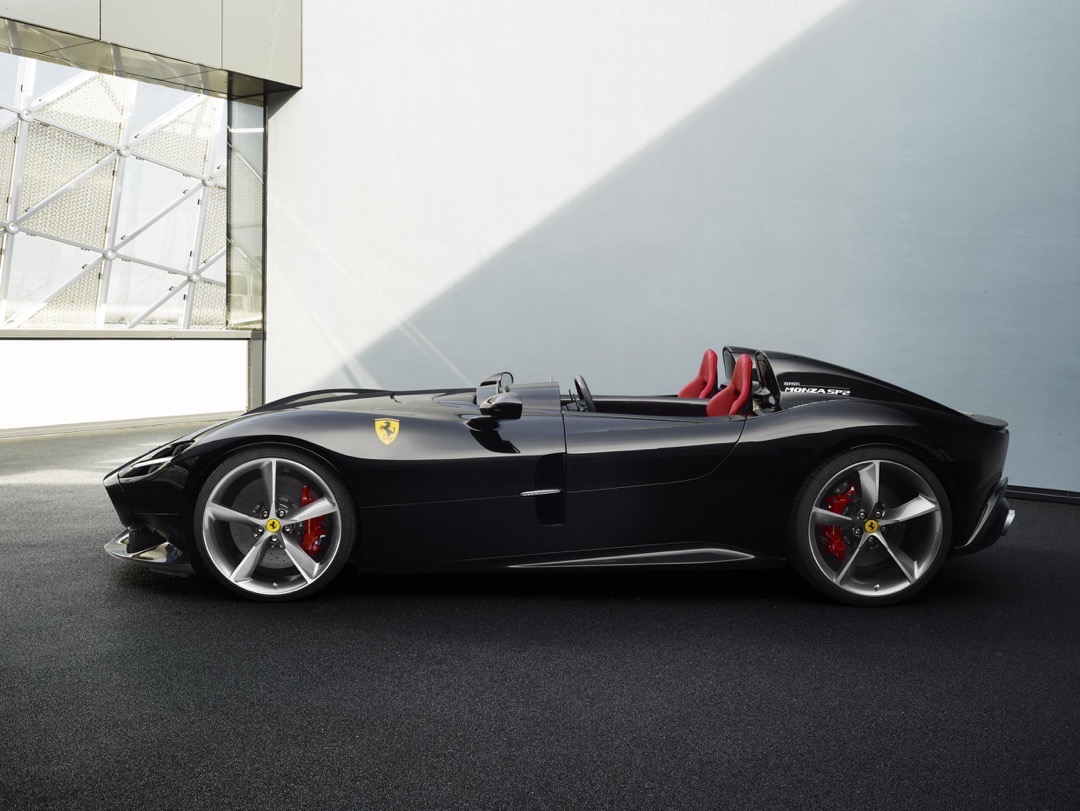
The SP2 is mechanically similar but has two seats. It is more usable because it allows the experience to be shared. For some buyers, that makes it the better car. A passenger can experience the V12, the exposure and the speedster sensation. For owners who attend events or drive with partners, friends or family, the SP2 makes more practical sense.
However, the SP2 loses some of the SP1’s single-seat purity. It feels more like an exotic open Ferrari and less like a personal racing barchetta. The better choice depends entirely on buyer philosophy: purity versus usability.
Tailor Made Specification
Because every Monza was allocated to high-level Ferrari clients, specification plays an important role. Paint, stripe designs, leather, Alcantara, carbon finishes, helmets, driving suits and bespoke details can all affect desirability. Ferrari even collaborated with luxury brands for driver apparel connected to the Monza experience, reinforcing that the car was sold as a lifestyle and design object, not merely a vehicle.
No Monza SP1 Aperta or Track Version
There is no need for a Spider version because the Monza SP1 is already fully open. There is also no track-only Monza derivative. The SP1 is not an XX-style circuit car. It is a collector speedster, and its value lies in preserving that original concept.
Market Distinction by Variant
For buyers, the main question is SP1 versus SP2. The SP1 is rarer, purer and more visually distinctive. The SP2 is more practical, more social and may appeal to a broader buyer pool. In long-term collector terms, the SP1’s single-seat configuration could become its greatest asset, but it also narrows the audience.
Specification Sensitivity
The best SP1 examples will likely be those with low mileage, tasteful specification, full Ferrari history and complete accessories. Highly individual specifications may command premiums if executed beautifully, but unusual colours can also reduce liquidity. At this level, provenance and presentation matter as much as mileage.
7. Driving Experience
The Ferrari Monza SP1 offers one of the most unusual driving experiences of any modern Ferrari. It is not simply an 812 Superfast without a roof. The absence of windscreen, roof and passenger seat transforms the way the driver experiences speed, sound and movement.
First Impressions
Getting into the SP1 already feels different. There is no normal cabin to retreat into. The driver sits exposed, low and surrounded by carbon fibre. The car feels more like a cockpit than an interior. The start-up of the V12 is not filtered through a luxurious GT environment; it is present and immediate.
The single-seat configuration also changes the psychology of the drive. There is no conversation, no passenger feedback, no shared experience. The SP1 is introspective in a strange way: it is just driver, car and road.
Low-Speed Driving
At low speeds, the SP1 is manageable but never relaxing in the way a Roma or 12Cilindri can be. The gearbox is modern, the controls are familiar and the car is not mechanically difficult, but the exposure means the driver is always aware of the environment. Dust, temperature, wind and road surface become part of the drive.
This makes ordinary journeys feel more special, but also more demanding. The SP1 is not a car for casual errands.
Fast Road Driving
On open roads, the car becomes more coherent. The V12 pulls hard, the steering responds quickly and the exposed cockpit makes the road feel alive. Even moderate speeds feel exciting because the driver is not insulated from the elements.
This is where the SP1 justifies itself. It does not need to be the fastest Ferrari to be one of the most memorable. The sensation of driving is intensified.
Long-Distance Use
Long-distance touring is possible but not ideal. Wind, noise and exposure become tiring over time. Weather is a major consideration. Owners will choose routes and conditions carefully. This is a car for selected drives, not all-purpose travel.
Emotional Character
The SP1’s emotional appeal is extremely high if the buyer understands the concept. It is not practical, not subtle and not broadly comfortable. But it delivers a driving experience that very few modern cars can match: a naturally aspirated V12 with almost nothing between the driver and the outside world.
8. Ownership Insights
Owning a Ferrari Monza SP1 is very different from owning a normal Ferrari. It is a limited-production Icona car, a collectible asset and a specialist driving machine. It requires careful storage, expert maintenance, serious insurance and realistic expectations about usability.
Running Costs
Indicative annual ownership costs can include:
- Insurance: approximately £20,000–£60,000+ / $25,000–$75,000+, depending on agreed value, location, storage and driver profile
- Servicing and annual inspection: £5,000–£15,000+ / $6,500–$20,000+, depending on usage
- Tyres: approximately £2,500–£5,000 / $3,000–$6,500 per set
- Paint protection film: £7,000–£15,000 / $9,000–$20,000
- Secure storage and battery conditioning: significant for collectors
- Event transport: potentially £2,000–£10,000+ / $2,500–$12,000+ depending on distance and logistics
These are indicative figures, but the principle is clear: the SP1 should be maintained like a major collector Ferrari, not like a regular sports car.
Servicing Reality
The SP1 should be serviced only through Ferrari’s official network or recognised Ferrari specialists with access to correct procedures and diagnostics. Although the V12 is derived from a proven Ferrari engine family, the car’s limited-production bodywork, trim, electronics and carbon-fibre components make proper care essential.
Damage repair can be especially expensive. Carbon-fibre body panels, bespoke paintwork and unique interior elements may require factory support or long lead times. A minor cosmetic issue on a normal car can become a major value concern on a Monza SP1.
Reliability Expectations
Mechanically, the SP1 benefits from the 812-derived V12 platform, which is generally well regarded when maintained correctly. However, low-mileage collector cars can develop their own issues if not used. Battery conditioning, fluids, tyres, seals and electronics all need attention.
A car stored for display must still be maintained properly. Lack of use is not the same as preservation.
Real-World Usability
The Monza SP1 is road legal in many markets, but it is not practical. There is no roof, no windscreen in the traditional sense, no passenger seat and limited protection from weather. Owners must plan drives around conditions.
It is best suited to:
- Private collections
- Ferrari events
- Concours appearances
- Special early-morning drives
- Dry-weather road use
- Collector gatherings
It is not suited to daily driving, poor weather or long-distance touring unless the owner accepts the discomfort as part of the experience.
Pre-Purchase Inspection
A PPI is essential. Buyers should verify Ferrari service history, factory documentation, paint condition, carbon-fibre condition, mileage, tyre age, interior wear, accessory completeness, accident history and whether the car has been exported or re-registered across markets.
9. Market Value & Depreciation
The Ferrari Monza SP1 is not a normal depreciation car. Original pricing was widely reported around €1.58 million before options, with US-market references often around $1.8–$2.0 million depending on taxes, specification and reporting basis. Today, public auction and listing data show that the Monza SP1 and SP2 market has moved substantially above original pricing in many cases.
Current Market Evidence
Auction results show the strength of the market. Public data lists a 2021 Ferrari Monza SP1 selling for $3.69 million at RM Sotheby’s Zurich in 2025, while another SP1 sold for $2.915 million at Gooding Christie’s Paris in 2026. Broader Monza auction records show SP1 and SP2 results from roughly the mid-$2 million range to nearly $5 million for the strongest SP2 example.
These results confirm that the Monza has moved firmly into collectible Ferrari territory. However, buyers should distinguish between asking prices, auction results and actual private transactions. Ultra-low-mileage examples with desirable specifications can command major premiums, but weaker specifications or market timing can affect outcomes.
Value Drivers
Key value factors include:
- SP1 versus SP2 configuration
- Mileage
- Exterior colour
- Interior specification
- Tailor Made details
- Complete accessories
- Ferrari service history
- Market region
- Ownership history
- Accident-free condition
- Whether the car has been publicly shown
- Originality
The SP1’s rarity within the Monza family may support long-term values, but the single-seat layout also narrows the buyer pool. Some collectors will pay more for purity; others will prefer the SP2 because it is easier to enjoy with a passenger.
Depreciation Risk
The SP1 is unlikely to depreciate like a production Ferrari, but values can still move. Collector markets are affected by interest rates, currency movements, broader economic conditions and Ferrari’s own future limited releases. A new Icona or halo model can sometimes shift attention temporarily.
Long-Term Outlook
The long-term outlook is strong because the SP1 has all the right collector ingredients: limited production, Icona-series status, V12 power, radical design, historical inspiration and allocation-only access. The best examples should remain highly desirable.
For buyers, the safest strategy is to buy the right car rather than the cheapest car. Specification, condition and provenance matter enormously.
10. Competitors
Ferrari Monza SP2
The SP2 is the most direct competitor because it shares the same platform, engine and design philosophy but adds a second seat. In practical terms, the SP2 is easier to enjoy because it allows a passenger to share the experience. It may therefore appeal to a broader market.
The SP1 is purer and arguably more collectible because of its single-seat layout. The SP2 is more usable and perhaps more emotionally generous. Buyers must decide whether they want the most radical version or the more shareable version.
Aston Martin V12 Speedster
The Aston Martin V12 Speedster is conceptually similar: a limited-production, roofless, windscreen-free speedster with a powerful front-mounted engine. However, it operates at a different level of brand prestige and market value. The Aston uses a twin-turbo V12 and offers a dramatic experience, but it lacks Ferrari’s Icona status and naturally aspirated V12 character.
The Aston is more accessible and arguably more usable in some ways. The Ferrari is more collectible, more exotic and more historically significant.
McLaren Elva
The McLaren Elva is another roofless speedster, but its philosophy is different. It is lighter, more modern and more aerodynamic in a contemporary supercar sense. McLaren’s Active Air Management System is conceptually similar to Ferrari’s Virtual Wind Shield, attempting to make windscreen-free driving more tolerable.
The Elva is more technical and arguably more focused on lightweight performance. The Monza SP1 is more emotional, more sculptural and more historically rooted. The Ferrari’s V12 also gives it a sound and character the McLaren cannot replicate.
Lamborghini Aventador J
The Lamborghini Aventador J is far rarer because it is a one-off, but it sits in a similar emotional category: roofless, extreme, V12-powered and created as a design statement. The Lamborghini is more outrageous and concept-car-like, while the Ferrari is more refined in execution.
For collectors, the Aventador J is almost impossible to compare because of its one-off status. The Monza SP1 is more obtainable but still extremely rare.
Ferrari Daytona SP3
The Daytona SP3 is the later Icona model and a more complete hypercar. It has a mid-mounted V12, targa roof, greater usability and stronger performance credentials. It is less radically exposed than the Monza SP1, but more usable and more technically complete.
The Monza SP1 is purer as a speedster. The Daytona SP3 is more rounded as a collector hypercar. Both matter, but they appeal to different instincts.
11. FAQs
What is the Ferrari Monza SP1?
The Ferrari Monza SP1 is a single-seat, limited-production V12 speedster and one of the first models in Ferrari’s Icona series. It was launched alongside the two-seat Monza SP2 and inspired by classic Ferrari racing barchettas such as the 166 MM, 750 Monza and 250 Testa Rossa.
How many Ferrari Monza SP1s were made?
Ferrari produced 499 Monza cars in total across the SP1 and SP2 variants. Ferrari did not produce 499 of each. The exact split between SP1 and SP2 is not officially broken down in most public sources, but the SP1 is widely believed to be the rarer version.
What engine does the Ferrari Monza SP1 use?
The Monza SP1 uses a 6.5-litre naturally aspirated V12 derived from the Ferrari 812 Superfast. It produces approximately 810 hp and 719 Nm / 530 lb ft of torque.
How fast is the Ferrari Monza SP1?
Ferrari quoted 0–100 km/h in 2.9 seconds, 0–200 km/h in 7.9 seconds, and a top speed of more than 300 km/h / 186 mph.
Does the Ferrari Monza SP1 have a roof or windscreen?
No. The Monza SP1 has no roof and no conventional windscreen. Ferrari developed a Virtual Wind Shield system to help manage airflow over the driver, but the car remains a highly exposed speedster experience.
How much does a Ferrari Monza SP1 cost?
Original pricing was reported around €1.58 million before options, with US references often around $1.8–$2.0 milliondepending on market. Recent public auction results have placed Monza SP1 examples around $2.9 million to $3.69 million, depending on mileage, specification and sale context.
Is the Ferrari Monza SP1 road legal?
The Monza SP1 was built as a road car, but legality and registration can depend on market-specific regulations. Owners should verify local requirements, especially because the car lacks a conventional windscreen and roof.
Is the Ferrari Monza SP1 a good investment?
It has strong collector potential because of its Icona status, limited production, naturally aspirated V12, single-seat layout and Ferrari allocation-only background. However, values still depend on specification, condition, mileage, provenance and broader collector-market trends.
12. Related Articles
- Ferrari Monza SP2
- Ferrari Daytona SP3
- Ferrari 812 Superfast
- Ferrari 812 Competizione
- Ferrari 12Cilindri
- Ferrari LaFerrari
- Ferrari F80
- Aston Martin V12 Speedster
- McLaren Elva
- Lamborghini Aventador J
- Ferrari 166 MM
- Ferrari 750 Monza
- Ferrari 250 Testa Rossa
13. Are You Ready?
- Looking to buy a Ferrari Monza SP1? Click to find available cars.
- Need insurance? Click to apply for Supercar Insurance.
- Need a service? Click to book a specialist service.
- Buying one? Click to request a PPI inspection.
- Selling your car? Click to request a valuation.